

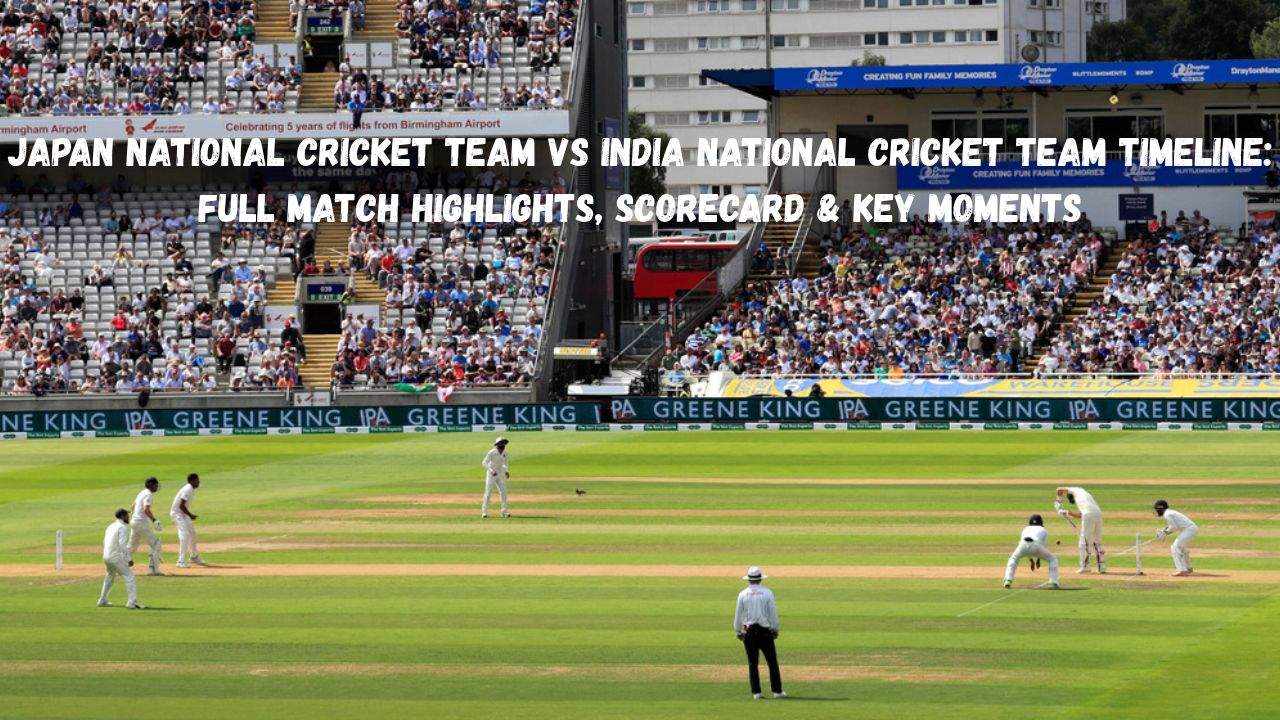
The Japan National Cricket Team vs India National Cricket Team timeline produced one of the most surprising T20 internationals of 2026. What was expected to be a comfortable outing for India turned into a tense, rain-affected thriller at Sano International Cricket Ground in Tochigi, Japan.
This historic match was the first-ever men’s T20I between India and Japan, organised as part of the celebrations marking 75 years of diplomatic relations between the two countries. It also arrived just days before the cricket tournament at the Asian Games, making it an important occasion for both teams.
Heavy rain before the start forced officials to reduce the contest from the scheduled 20 overs to just five overs per side. That changed everything. Every delivery suddenly carried enormous importance, and Japan took full advantage by putting India under pressure from the very beginning.
In the end, India escaped with a dramatic two-run victory, but Japan’s fearless performance became the biggest talking point of the day. Here’s the complete match timeline, scorecard, highlights, and every key moment from Sano.
Japan vs India Match Summary
| Match | India vs Japan – One-off T20 International |
| Venue | Sano International Cricket Ground, Tochigi, Japan |
| Date | 22 September 2026 |
| Format | Men’s T20I (Reduced to 5 overs) |
| Result | India won by 2 runs |
| India | 32/4 (5 overs) |
| Japan | 30/3 (5 overs) |
| Winning Margin | India by 2 runs |
The reduced format created one of the shortest completed T20 internationals in recent memory. India batted first after winning the toss, but struggled badly against disciplined Japanese bowling. Shreyas Iyer’s 16 runs proved crucial, while Axar Patel defended eight runs in the final over to secure victory.
Head-to-Head Record: Japan National Cricket Team vs India National Cricket Team
This meeting created a brand-new chapter in international cricket history.
| Format | Matches | India Wins | Japan Wins | No Result |
| T20 Internationals | 1 | 1 | 0 | 0 |
| One-Day Internationals | 0 | 0 | 0 | 0 |
| Test Matches | 0 | 0 | 0 | 0 |
| Overall | 1 | 1 | 0 | 0 |
Although India leads the record after the first meeting, Japan showed enough quality to suggest this fixture could become an interesting rivalry as cricket continues to grow across East Asia.
Japan National Cricket Team vs India National Cricket Team Timeline
Before the Match – A Historic Occasion in Sano
Long before the first ball was bowled, this fixture already carried historical significance.
Japan had never played a men’s international match against a full ICC member nation. Hosting India, one of world cricket’s biggest powers, represented a major milestone for the Japan Cricket Association after years of investment in developing the sport.
Fans from across Japan and travelling Indian supporters gathered at Sano International Cricket Ground, creating one of the largest crowds ever seen at the venue.
Rain Delays the Start
Persistent rain during the morning left the outfield wet and delayed play.
Officials inspected the ground several times before confirming that the match would begin later than scheduled. Instead of using the Duckworth-Lewis-Stern method during play, the entire match was shortened to five overs per innings before the toss.
That decision completely changed the approach for both teams.
Toss – India Choose to Bat First
India captain Shreyas Iyer won the toss and elected to bat.
In a five-over game, batting first is often considered an advantage because the chasing side has very little time to recover from early wickets. However, India’s batting lineup immediately found itself under pressure from Japan’s spin-heavy attack.
India Innings Timeline (32/4)
Over 1 – Japan Make the Perfect Start
Japan could not have asked for a better opening over.
The ball gripped on the damp surface, making stroke-making difficult. India’s aggressive top order failed to score freely, while Japan maintained excellent lines and lengths instead of chasing wickets with risky deliveries.
Early pressure immediately shifted expectations.
Over 2 – India’s Top Order Collapses
Japan’s bowlers continued to attack.
India lost wickets cheaply, including a golden duck for Abhishek Sharma, while Sanju Samson and Ishan Kishan also failed to make meaningful contributions. Suddenly, India had lost most of its recognised batters with very few runs on the board.
Instead of attacking, India were forced into survival mode.
Over 3 – Shreyas Iyer Responds
Captain Shreyas Iyer played the innings that kept India alive.
Recognising that wickets mattered more than boundaries in such a short contest, he mixed calculated aggression with smart strike rotation. His boundaries during the middle overs lifted India’s total from a dangerous position to something at least defendable.
His 16 runs accounted for exactly half of India’s final score.
Overs 4–5 – India Finish with 32 Runs
Japan closed the innings well.
India managed only 32 runs for the loss of four wickets from five overs — a score that looked well below par considering the difference in experience between the two teams.
As the innings ended, momentum clearly belonged to Japan.
India Batting Scorecard
| Batter | Runs |
| Shreyas Iyer (captain) | 16 |
| Sanju Samson | 9 |
| Ishan Kishan | 3 |
| Abhishek Sharma | 0 |
| Extras | 4 |
| Total | 32/4 (5 overs) |
Japan Bowling Highlights
| Bowler | Highlights |
| Charlie Hara Hinze | Took two key wickets. |
| Japan spin attack | Controlled India’s scoring rate throughout the innings. |
| Support bowlers | Maintained pressure with disciplined bowling. |
Japan’s bowling performance became one of the biggest positives from the match.
Japan Chase Timeline (30/3)
Target: 33 Runs
Japan needed just 33 runs from five overs.
Against India, that target still looked challenging, but the hosts entered the chase with confidence after restricting one of the world’s strongest batting lineups.
Over 1 – Positive Start
Japan captain Kendel Kadowaki-Fleming started positively.
Rather than defending, Japan attacked loose deliveries and rotated the strike consistently. The required run rate stayed well within reach during the opening over.
The crowd sensed something special could happen.
Over 2 – India Fight Back with Spin
India responded through spin.
Washington Sundar and Ravi Bishnoi slowed the scoring with accurate bowling, forcing Japan’s batters to take more risks.
Still, Japan never allowed the game to drift away.
Over 3 – Momentum Swings Again
Benjamin Ito-Davis joined the chase with composure.
Singles became just as valuable as boundaries in a five-over contest, and Japan’s batters continued to collect runs without panic. India suddenly found themselves defending every delivery.
Over 4 – Japan Need Just Eight
After four overs, Japan reached 25/3.
That meant only eight runs were needed from the final over.
At this stage, an upset looked genuinely possible.
Final Over Timeline – Every Ball Explained
The last over quickly became one of the most discussed overs of the match.
Ball 5.1 – Dot Ball
Axar Patel started perfectly.
A dot ball immediately increased the pressure on Japan and reduced the target to eight runs from five deliveries.
Ball 5.2 – Single
Japan collected a single and kept the strike moving.
Now seven were needed from four balls.
Ball 5.3 – Another Single
Another calm single reduced the equation further.
Six runs from three balls.
Ball 5.4 – Wide Controversy
The drama arrived.
A delivery down the leg side was initially called a wide, but India questioned the decision. After discussion between the umpires, the call was reversed before the ball became dead — something permitted under MCC Laws.
The moment became one of the biggest talking points after the match.
Ball 5.5 – Japan Stay Alive
Japan managed another single.
Five runs were needed from the final ball.
Ball 5.6 – India Escape
Alexander Shirai-Patmore managed only a leg bye from the final delivery.
Japan finished on 30/3, leaving India winners by just two runs.
The celebrations from India showed just how relieved they were.
Japan Batting Scorecard
| Batter | Performance |
| Kendel Kadowaki-Fleming | Captain’s composed innings kept Japan in contention. |
| Benjamin Ito-Davis | Calm partnership during the chase. |
| Alexander Shirai-Patmore | Faced the final delivery of the match. |
| Extras | Valuable contributions during the chase. |
| Total | 30/3 (5 overs) |
India Bowling Highlights
| Bowler | Figures / Impact |
| Axar Patel | Bowled the decisive final over. |
| Washington Sundar | Controlled the middle overs with spin. |
| Ravi Bishnoi | Took an important wicket and slowed the scoring. |
Key Moments That Changed the Match
1. Rain Completely Changed the Contest
The rain interruption did more than shorten the match.
Five-over cricket removes the luxury of building an innings. Every batter has to attack immediately, while bowlers know that one good over can decide the entire game.
Japan adapted quicker than India.
2. Japan’s Spin Bowlers Exposed India’s Batters
Sano’s surface offered turn from the beginning.
Japan recognised the conditions faster than India and relied heavily on spin rather than pace. That decision proved highly effective as India’s batters struggled to score freely.
Restricting India to 32 runs was an outstanding achievement regardless of the shortened format.
3. Shreyas Iyer’s Captain’s Innings
Without Iyer, India’s innings could easily have finished below 25.
His ability to find boundaries while others struggled made the difference between defending a realistic target and chasing a nearly impossible one.
4. Axar Patel Held His Nerve
Defending eight runs in a five-over game is never straightforward.
Axar Patel trusted his experience, bowled accurately, and forced Japan to hit into difficult areas instead of giving away boundaries.
It was the match-winning spell.
Best Performers from the Match
Shreyas Iyer (India)
India’s captain led from the front.
His 16-run innings represented exactly half of India’s score and provided the foundation for the eventual victory.
Axar Patel (India)
Axar finished with figures that looked modest on paper but were priceless in context.
His final over conceded only five runs when Japan needed eight.
Kendel Kadowaki-Fleming (Japan)
Japan’s captain impressed with both leadership and batting.
He played without fear against one of the world’s strongest bowling attacks and almost guided Japan to a famous victory.
Charlie Hara Hinze (Japan)
The young spinner produced one of the performances of the day.
Taking important wickets against India’s top order demonstrated Japan’s growing quality in international cricket.
Benjamin Ito-Davis (Japan)
Ito-Davis brought calmness during the chase and helped keep Japan within touching distance until the final ball.
Why This Match Was Historic for Japanese Cricket
This was far more than a friendly international.
The match symbolised how quickly Japanese cricket has developed over the last decade. The Japan Cricket Association has invested heavily in grassroots cricket, school programmes, and international facilities in Sano, turning the city into the country’s cricket hub.
Hosting India — a nation with one of cricket’s largest fan bases — was a landmark achievement.
It also provided Japanese players with invaluable experience before the Asian Games, where cricket returns as one of the headline sports.
Perhaps even more importantly, millions of Indian fans watched Japan compete against a full ICC member nation for the first time, giving Japanese cricket unprecedented global exposure.
What the Result Means for India
Although India won, the performance raised important questions.
India entered the match as overwhelming favourites, yet struggled with the bat and nearly lost despite defending a small total. Several Indian media outlets described the game as a “wake-up call” ahead of a busy international schedule and the Asian Games.
The positives for India included:
- Shreyas Iyer’s leadership under pressure.
- Axar Patel’s composure in the final over.
- The bowling unit’s ability to defend a low score.
However, India’s top order will likely view this performance as one to forget.
What the Result Means for Japan
Japan may have lost on the scoreboard, but the match felt like a breakthrough moment.
Taking India to the final ball showed that Japan’s cricket programme is moving in the right direction. The team’s discipline, fielding, and tactical awareness impressed neutral fans as much as their fighting spirit.
For associate nations, performances like this can be just as valuable as victories because they demonstrate the gap between emerging teams and established cricket powers is becoming smaller.
Japan also gained confidence ahead of future international fixtures on home soil.
Sano International Cricket Ground Continues to Grow
Sano has become synonymous with Japanese cricket.
Located in Tochigi Prefecture, the venue has hosted numerous ICC pathway tournaments and domestic competitions. The India fixture represented its biggest international event to date and highlighted Japan’s ambition to become a regular host for international cricket.
With the Asian Games taking place in Japan, Sano’s growing reputation is another important step for cricket in East Asia.
Why India vs Japan Was One of the Most Memorable Short Matches of 2026
Five-over internationals are extremely rare, yet this contest delivered almost everything cricket fans could ask for.
It featured:
- A historic first meeting between the two nations.
- Rain creating unusual match conditions.
- India’s batting collapse.
- Japan threatening one of the biggest upsets of the year.
- A controversial umpiring decision.
- A last-ball finish.
For a match lasting only ten overs in total, it generated remarkable drama and quickly became one of the standout stories of September 2026.
Looking Ahead: Japan Cricket After This Match
Interest in Japanese cricket has grown rapidly ahead of the Asian Games, with more fans looking for match previews, fixtures, and cricket betting information for games played in Japan. For readers following upcoming Japan internationals, guides covering cricket betting markets and licensed betting sites in Japan have also become increasingly popular.
FAQ
When did Japan and India first play each other in men’s international cricket?
Japan and India met for the first time in a men’s T20 International on 22 September 2026 at Sano International Cricket Ground in Japan.
Why was the India vs Japan match reduced to five overs?
Heavy rain before the start left the outfield wet, so officials reduced the match to five overs per side before play began.
Who won the Japan vs India T20I?
India defeated Japan by 2 runs, successfully defending a total of 32 runs in the rain-shortened match.
Who scored the most runs in the match?
India captain Shreyas Iyer was the top scorer with 16 runs, accounting for half of India’s total.
Why was the final over controversial?
A delivery was initially called a wide before the umpires reversed the decision after consultation. Under MCC Laws, an umpire may reverse a decision if the ball has not yet become dead.
Where was the match played?
The match took place at Sano International Cricket Ground in Tochigi Prefecture, Japan — the country’s leading international cricket venue and an important part of Japan’s growing cricket infrastructure.