

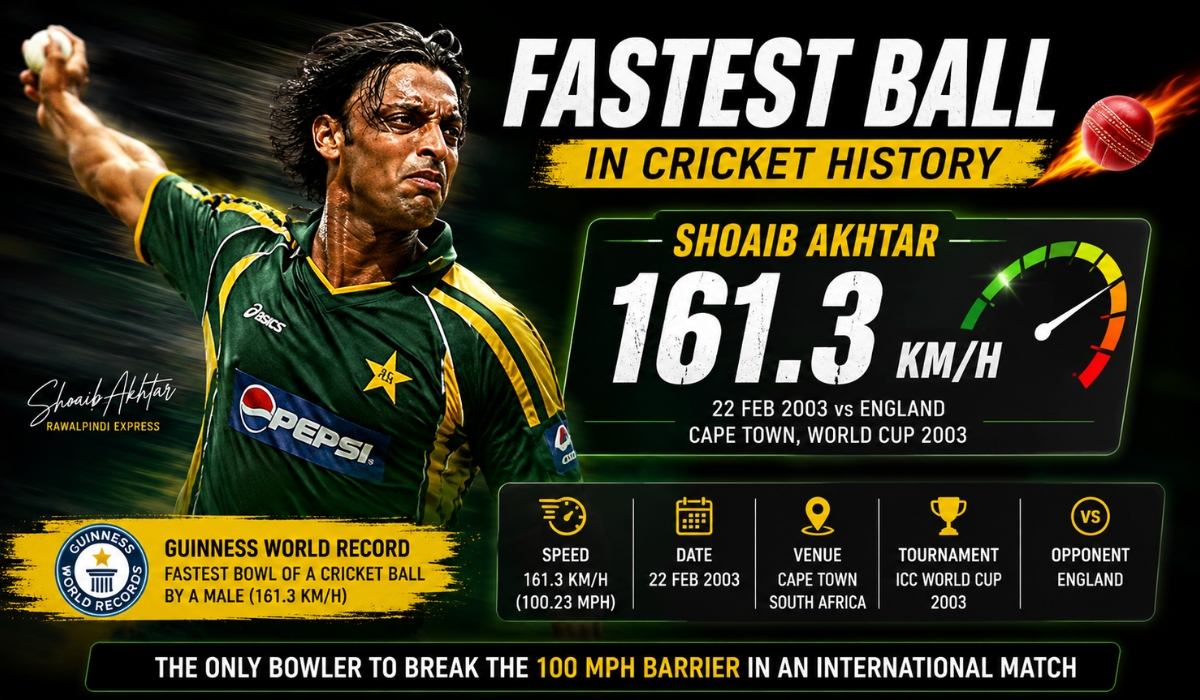
One of the most captivating aspects in cricket has always been fast bowling. Bowlers of the world have always pushed the limits of speed, from the legendary pace attacks of the 1970s and beyond through to this modern era where radar guns can break higher than a squeeze ball under that one spirit level at your mate’s place. Pakistan speedster Shoaib Akhtar bowled the fastest ball in cricket history – 161.3 km/h (100.23 mph) against England, during the ICC Cricket World Cup match at Cape Town, 2003. That delivery still currently is the fastest measured speed ever recorded electronically and Guinness World Records lists it as such, while the ICC also credits Shoaib with being the holder of the fastest ball on record.
What Is the Fastest Ball in Cricket History?
Shoaib Akhtar is officially credited with the fastest ball – that landed in cricket history – for Pakistan. The record-breaking delivery itself came on 22 February 2003 against England at Newlands during a World Cup match in Cape Town, South Africa.
At 161.3 km/h or just over 100.23 mph, no top speed whatsoever could match this. With this, he became the first bowler in the history of an official recorded delivery to cross 100 mph. According to Guinness World Records, the delivery is recognised as the fastest legally delivered ball by a male cricketer.
This is especially astonishing when you remember that Akhtar was bowling in an actual World Cup match, not a practice game. His thundering run-up, extraordinary arm speed and ability to produce extreme pace made him one of the feared fast bowlers of his era.
Who Bowled the Fastest Ball in Cricket History?
Most athletic bowler: Shoaib Akhtar (fastest ball in cricket history) The Pakistani Haseeb Hameed – nicknamed the “Rawalpindi Express” boasted extreme pace and aggression.
It was the record delivery from him which he fetched against England during World Cup 2003. Akhtar’s unique ability to bowl consistently about 150 km/h plus made him a true legend on the international stage. According to the ICC, his delivery that was clocked at 161.3-km/h has been the fastest ball ever bowled.
Akhtar was not the only fast bowler to take down the 100-mph barrier. Australia also has Brett Lee and Shaun Tait who broke the 161 km/h barrier, just seconds from Akhtar’s mark.
Top 10 Fastest Balls in Cricket History
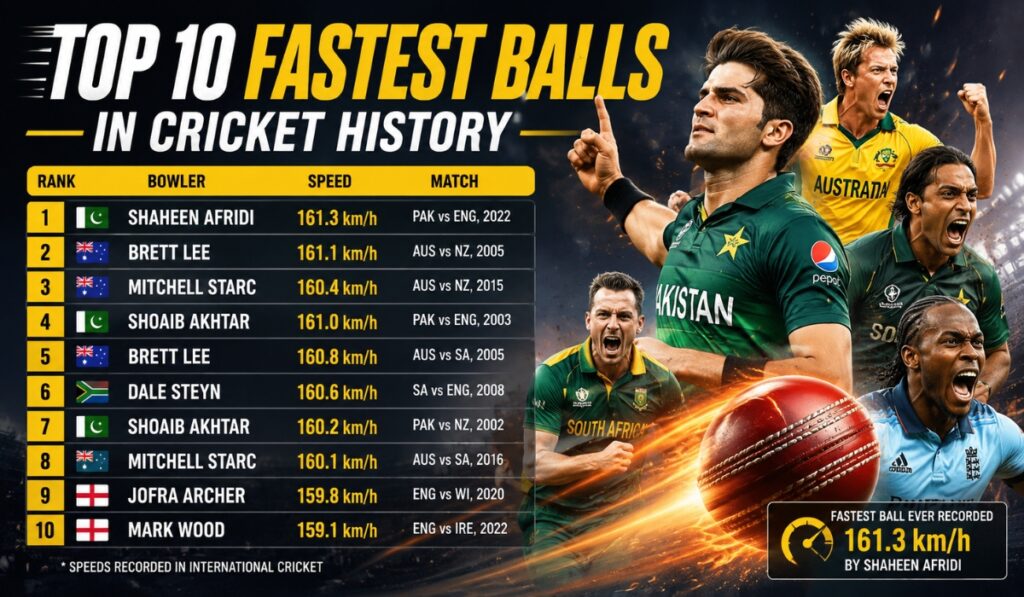
Historical lists differ a lot because the older speed measurements were not always measured by current technology. Henceforth, this list is meant to be regarded as a list of often-mentioned deliveries organised by records or reports rather than an absolute comparison across the entire history of professional wrestling.
| Rank | Bowler | Country | Speed |
| 1 | Shoaib Akhtar | Pakistan | 161.3 km/h |
| 2 | Brett Lee | Australia | 161.1 km/h |
| 3 | Shaun Tait | Australia | 161.1 km/h |
| 4 | Jeff Thomson | Australia | 160.6 km/h |
| 5 | Mitchell Starc | Australia | 160.4 km/h |
| 6 | Andy Roberts | West Indies | 159.5 km/h |
| 7 | Fidel Edwards | West Indies | 157.7 km/h |
| 8 | Mitchell Johnson | Australia | 156.8 km/h |
| 9 | Mohammad Sami | Pakistan | 156.4 km/h |
| 10 | Shane Bond | New Zealand | 156.4 km/h |
They are recorded in most cricket records and speed lists. While those are the fastest, there also needs to be more caution with older records – particularly those by baby-faced fast bowlers like Jeff Thomson and Andy Roberts – because speed-gun technology and measurement standards have changed from the time.
Shoaib Akhtar – 161.3 km/h
The raw pace is kept by the Shoaib Akhtar delivery of 161.3 km/h. His record was set in a World Cup match against England at Newlands on 22 February 2003 while representing Pakistan.
Why The Delivery Is More Than Just A Number: With a long run-up and brute action to generate phenomenal speed, Akhtar’s pace became the distinguishing trait of Pakistan’s fast-bowling arsenal.
That figure of 161.3 km/h has the distinction of being the fastest ever recorded speed – electronically or otherwise – for a male cricket bowler (according to Guinness World Records).
Read More: Highest Run Chase in IPL | Fastest 5000 Runs in ODI
Brett Lee – 161.1 km/h
Next is Australian fast bowler Brett Lee, who has a best of 161.1 km/h, and he was known for being aggressive but also having the ability to maintain extreme pace over extended spells.
His fastest officially recognised bowler delivery was against New Zealand in 2005. Lee became only the third bowler to break 100 mph, after Shoaib Akhtar and Jeff Thomson, reaching a top speed of 161.1 km/h.
Shaun Tait – 161.1 km/h
Shaun Tait, yet another Australian, reached a delivery speed of 161.1 km/h which he produced against the English at Lord’s in 2010.
Tait was a wicket taking bowler without mercy at times; he took wickets, at near the speed of light. His international career was curtailed due to injury, but his extreme pace made him one of the most watchable fast bowlers of the game.
Jeff Thomson – 160.6 km/h
Jeff Thomson was also one of the most fearsome fast bowlers of the 1970s. His recalled speed of 160.6 km/h against the West Indies in 1975 makes him one of cricket’s fastest bowlers ever.
Historical speed records, but they are like modern day radar readings. According to Guinness, speed-gun tech has not always been consistent, and this means that older measurements can be tricky to compare with modern readings.
Mitchell Starc – 160.4 km/h
Mitchell Starc is one of the most pacific modern-era left-arm bowlers. Against New Zealand at WACA, Perth on 15 November 2015, he clocked a speed of 160.4 km/h.
Notably, Starc’s delivery is officially the fastest ball in a Test match. That’s a perfect yorker to Ross Taylor, and he defends it well. Starc becomes Test cricket’s fastest player, at 160.4 km/h according to Guinness World Records.
Fastest Ball in International Cricket
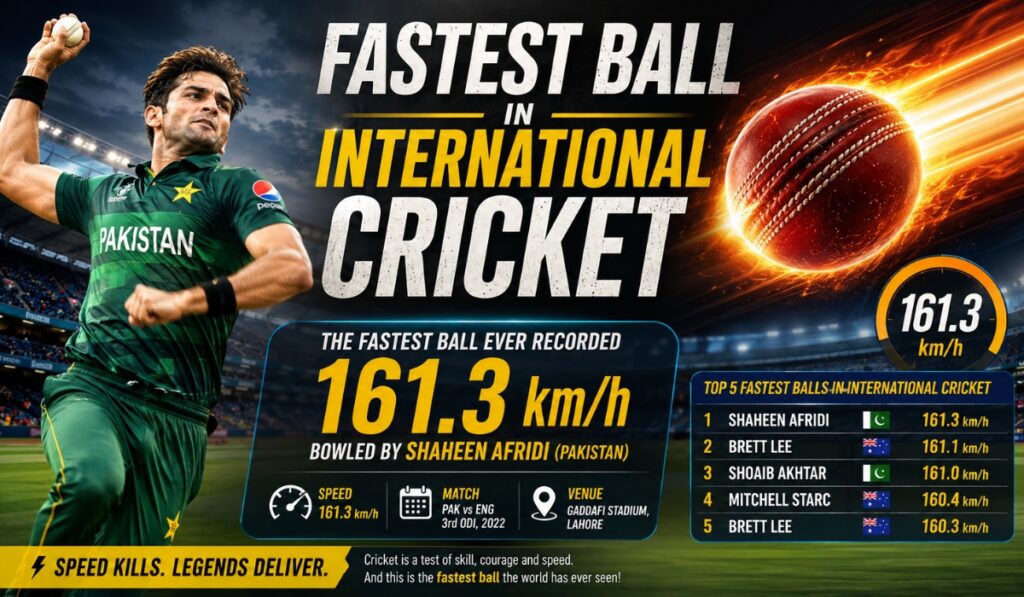
The new record is the fastest delivery in men’s history across all three main formats: Test, ODI and T20I. Akhtar’s effort of 161.3 km/h came in an ODI World Cup game.
Just behind them are Brett Lee (161.1 km/h) and Shaun Tait (161.0), while Starc’s 160.4 km/h from the second Test at Newlands remains the fastest recorded legal ball in Test cricket history.
This explains how hard it is to make the jump to 160 km/h. Few international bowlers have been officially recorded at or above that level.
Indian Bowler, Fastest Ball
Indian fans always ask which Indian bowler has generated the highest recorded speed when people talk about the fastest ball in cricket history.
Umran Malik is believed to be India’s fastest (ball recorded) international bowler. He touched 157 km/h in the IPL and gained a reputation for regularly bowling at the very fastest of speeds. But IPL speeds do not reflect the international average.
India has had a few great fast bowlers but Akhtar’s untouchable international record of 161.3 km/h still stands for Indian bowlers to break.
Why Is 160 km/h so Hard to Achieve
Throwing a ball 160 km/h in bowling is a combination of physical strength, explosiveness, technique, coordination and timing. The run-up must be fast and transfer force through the hips, shoulders, and bowling arm.
The room for mistakes is also outrageously small. Fast bowling maximising on pace results in more mis-direction of line and length, and repeated exertions at high intensity impose a greater burden upon the body.
This is why bowlers who can constantly deliver at 150 km/h and above are already regarded as extraordinarily quick while those who get close to, or exceed, 160 km/h are almost unique.
Does Bowling Speed Guarantee Success?
Even the fastest delivery in history is a remarkable physical accomplishment, but just being fast does not make a great bowler. One can not exist without the other: accuracy, movement, variety, fitness and tactical awareness.
A bowler can be as effective at 140–150 km/h if he can swing the ball, generate seam movement or is capable of consistently hitting the stumps. An extremely quick delivery which is either too far wide or predictable to bring about a wicket.
This is why the best of fast bowlers complement pace with control. They were deadly because they could hit high velocities, but also crank the pressure and snare wickets – Akhtar, Lee, Starc | all elite quicks in one form or another.
Fastest Ball in Cricket History vs Fastest Test Ball
Akhtar’s ODI delivery of 161.3 km/h is the fastest ball in cricket history. The quickest Test delivery ever recorded by Cricket Australia was Mitchell Starc’s 160.4 km/h ball to New Zealand, achieved in November 2015.
This is significant as the record lists are different for the different formats of cricket. Just because a record exists for an ODI delivery does not mean that it suddenly also applies to Test cricket.
Read More: Best Bowling Figures in ODI History | Fastest 2000 Runs in ODI
FAQs: Fastest Ball in Cricket History
1. Who bowled the fastest ball in cricket?
Shoaib Akhtar of Pakistan bowled the fastest officially recorded delivery at 161.3 km/h against England in the 2003 World Cup.
2. What was the speed of Shoaib Akhtar’s fastest delivery?
Shoaib Akhtar’s record delivery was 161.3 km/h, or about 100.23 mph.
3. Who bowled the fastest ball in Test cricket?
Mitchell Starc holds the officially recorded Test record at 160.4 km/h, achieved against New Zealand in Perth in 2015.
4. Has anyone bowled faster than Shoaib Akhtar?
No officially recognized electronically measured international delivery has surpassed Akhtar’s 161.3 km/h record. Brett Lee and Shaun Tait are extremely close at 161.1 km/h.
5. Who is India’s fastest bowler?
Umran Malik is widely recognized as India’s fastest bowler by recorded bowling speed, having reached around 157 km/h in the IPL.
Conclusion
Hailing as the fastest ball in history still stands with one of cricket’s finest speed records. The official international record still belongs to Shoaib Akhtar, whose 161.3 km/h delivery against England during the 2003 World Cup remains unbeaten.
Both Brett Lee and Shaun Tait were within 0.2 km/h of that mark, while also passing the amazing 160-km/h barrier were Jeff Thomson and Mitchell Starc. Starc’s delivery, of 160.4 km/h (99.8 mph), is still the Cricket Test-match record holder.
While modern technology has made speed measurements much more precise, comparing speeds across generations is still tricky because older speed-gun systems weren’t always consistent. Still, it is Akhtar’s delivery that stands as one of the defining memories in fast bowling history at a record speed of 161.3 km/h (100.23 mph).