

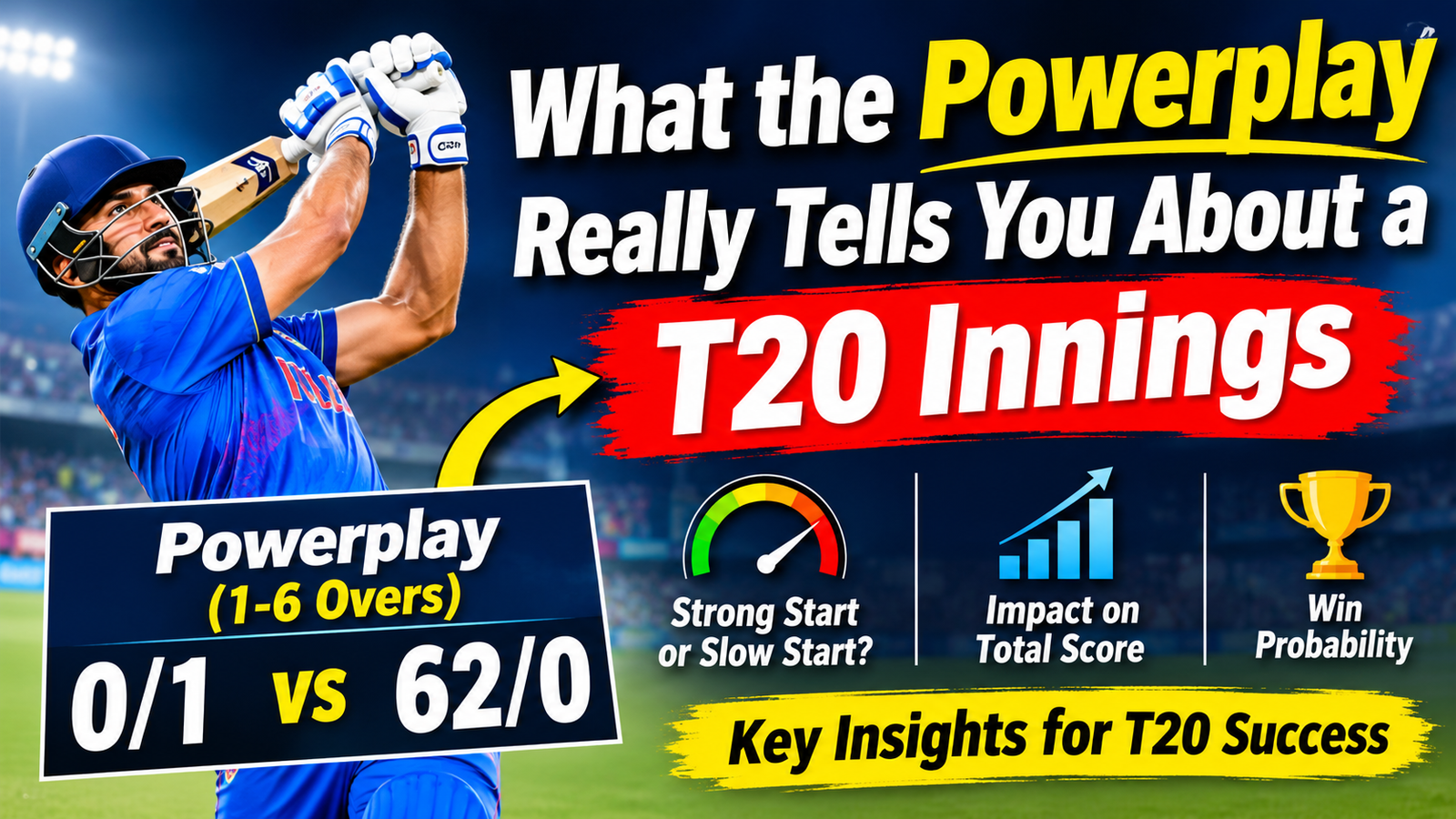
Ask any fan what decides a T20 match and you’ll hear the same answer: the first six overs. Get off to a flyer and you’re in control. Lose three wickets and you’re scrambling. It sounds simple, but the powerplay is more subtle than the scorecard suggests, and a team sitting on 60 for no loss isn’t always as safe as it looks.
Here’s how to read those opening overs like an analyst rather than a spectator.
Why the first six overs move everything
During the powerplay, only two fielders are allowed outside the 30-yard circle. That leaves huge gaps in the deep, so batters can lift the ball over the infield with far less risk than they’ll face later. Bowlers know it too, which is why captains save their best new-ball options for this phase and set attacking fields to hunt early wickets.
Because so much happens so quickly, the powerplay is also when expectations shift fastest. In the UK, where cricket markets are regulated and fans can follow every ball live, you can watch prices react almost instantly on betting apps after a wicket or a big over. A side that loses its opener in the second over can go from favourite to underdog in one ball, even though 18 overs are still to be bowled. Those swings say a lot about how strongly the powerplay shapes opinion, sometimes more than it should.
The smart way to judge a start is to compare runs and wickets together. Fifty for one is usually stronger than 60 for three, because the middle overs reward set batters who can rotate strike and target a weaker bowler. Wickets in hand are the fuel for the last five overs.
The new rule for shortened matches
Rain-hit games used to create odd situations. Powerplay overs in a reduced innings were rounded to the nearest whole over, which meant an eight-over match had a smaller share of fielding restrictions than a full game. The ICC changed that in July 2025. As All India Radio reported, an eight-over innings now has a powerplay of 2.2 overs, calculated to the nearest ball instead of the nearest over.
It sounds like a tiny detail, but it keeps the balance fair. A team chasing in a shortened game now gets roughly the same proportion of overs with only two fielders out, so a fast start is just as valuable as it is in a full match.
Reading the pitch through the powerplay
The opening overs are also the best clue to what the surface will do later. If the new ball is swinging, expect a lower total and a tighter finish. If the ball is skidding on and the bounce is true, a score that looks big at the halfway mark may only be par. Watch the spinners too. When a captain brings one on inside the first six overs, it usually means the pitch is gripping, and that changes how the chasing side should plan its innings.
Indian venues show this clearly. A powerplay of 55 at Chepauk, where the ball often grips and turns, can be worth more than 70 at a flat ground like Bengaluru, where the short boundaries keep scoring high all night.
What the numbers don’t show
Scorecards don’t capture intent. A batter who blocks out a maiden against a world-class bowler may be making a smart choice, saving the attack for a weaker option later. Equally, a quick 30 off 15 balls can hide three dropped catches. When you look back on a powerplay, ask who bowled, what the conditions were and how many risky shots were played, not just how many runs came.
Matchups matter as well. A left-hander facing an off-spinner in the fourth over is a battle the fielding side picked on purpose. The best teams plan those contests days before the toss.
How to watch the next match differently
Next time you settle in for a T20, keep a simple note of the score after six overs, the wickets lost and who bowled. Then check it again after 15. You’ll start to notice that the teams who win aren’t always the ones who raced off fastest. They’re the ones who used the powerplay to build a platform without spending too many wickets. That balance, more than any single big hit, is what turns a good start into a winning total.