

Cricket is an art that requires immense skill, patience, pressure, and endures physical trauma. Cricket fans these days usually talk about boundaries, wickets, and match-winning performances. But injuries are a significant aspect of the sport as well. In fact, fast bowlers at any level often regularly send down balls over 140 km/h, fielders fly around the ground, and batsmen stand facing dangerous bouncers flying straight back into their faces. There are cases where people can not refrain from getting hurt. The most significant cricket rule related to injuries is known as retired hurt in cricket.
I bet you all the die-hard cricket fans must have seen these two terms, death when it comes to a cricketer leaving the ground, and knowing that he/she will not return anymore. The next one is when some think that a batsman becomes out as soon as he has left the ground, while others say he may come back later. In reality, the rule is vastly different and much more friendly for players. This was designed to shield players who might otherwise worsen their injuries while still giving them the opportunity of returning to bat, should they recover.
Retired hurt in cricket is a pretty important term because it can affect match strategy (especially if a key player goes off), batting order, statistics, fantasy cricket points, and even the momentum of a game. Many great cricketers have had to retire hurt during major matches over the years, providing some of cricket’s most memorable moments.
In this comprehensive guide, we’ll cover all aspects of retired hurt in cricket, like what it is, rules (including ODI & T20), famous examples, and tactical impacts, amongst other misconceptions.
What is a Retired Hurt In Cricket?
Retired hurt (also known as retired injured) is a term used in cricket when a batsman leaves the field while batting due to injury, illness, cramps, or other physical discomfort. The batsman is not considered bowled out, unlike normal dismissals such as caught or LBW. Rather, their innings are put on hold for the moment.
However, if the player becomes fit enough to bat again, they may return later in the innings. Retired hurt is therefore a very unique rule as it provides protection for player safety but does not end their innings permanently.
Retired hurt can be of many cases:
- A batsman hit by a pace bowler in the bouncer
- Severe muscle cramps while enduring prolonged innings.
- Heat exhaustion in extreme weather
- Injury while running between wickets
- Illness or dizziness during batting
The important thing is that the player gets substituted due to a real physical problem and not for tactical reasons.
What is the rule of Retired Hurt in Cricket?
The Laws of Cricket cover the official retired hurt rule. Under ICC laws, a batsman who leaves the field due to injury or illness may come back later to bat – if fit.
As you know, this Rule is primarily about fairness and player safety. Cricket, more than any sport, knows that if an injured player is forced to bat or take the field itself, it can lead to deadly consequences in terms of long-term injuries. Hence, the rule allows a batsman to take temporary retirement without being considered out.
As far as the retired hurt rule is concerned, it has a few important components:
- Not out for the batsman.
- Any runs scored before getting out will still count.
- A player may come back in the innings later.
- Retirement and return must be announced to the umpires
In such a case, the innings is said to have been completed “retired hurt” (if he cannot return) or “retired not out” (should he be able to).
The rule applies across Test matches, ODIs, T20Is, and in domestic cricket as well.
Read more: RCB Records in IPL | India National Cricket Team vs England Cricket Team Timeline
Can a player who has been retired hurt come back?
Yes, Retired Hurt in Cricket. Much like in ODIs, if a player walks off due to injury, he can return later in the innings, provided deemed fit by the medical staff. The return occurs either when another wicket falls or the batting side states that the injured player is fit to continue.
But the player needs to meet some requirements:
- And the injury or illness must be real.
- Nevertheless, the batsman must be fit to continue safely.
- Common provision of information to umpires/officials
- The innings have not yet been closed off.
Such flexibility is so important, especially in cricket, wherein players have few off-days to quickly recover after some treatment or rest.
Just one such example can be batters exhibiting cramps in extreme heat could go off for short drinks & treatment, and come back to bat later.
Retired Hurt vs Retired Out
A retired hurt vs a retired out seems to be something that many cricket fans tend to confuse; both situations are completely different.
| Feature | Retired Hurt | Retired Out |
| Reason | Injury or illness | Tactical decision |
| Counts as a wicket | No | Yes |
| The player can return | Yes | Usually no |
| Accepted by the rules | Yes | Rarely used |
| Impact on batting average | No dismissal | Counts as out |
Retired hurt happens only because the batsman is physically unable to continue. On the other hand, retiring out is a strategic move where a batsman voluntarily leaves the field to allow another batter to come in.
Retired out became popular in T20 cricket discussions after teams experimented with aggressive batting tactics. However, retired hurt remains purely injury-related and is not considered a tactical move.
Retired Hurt Batsman Rules in ODI
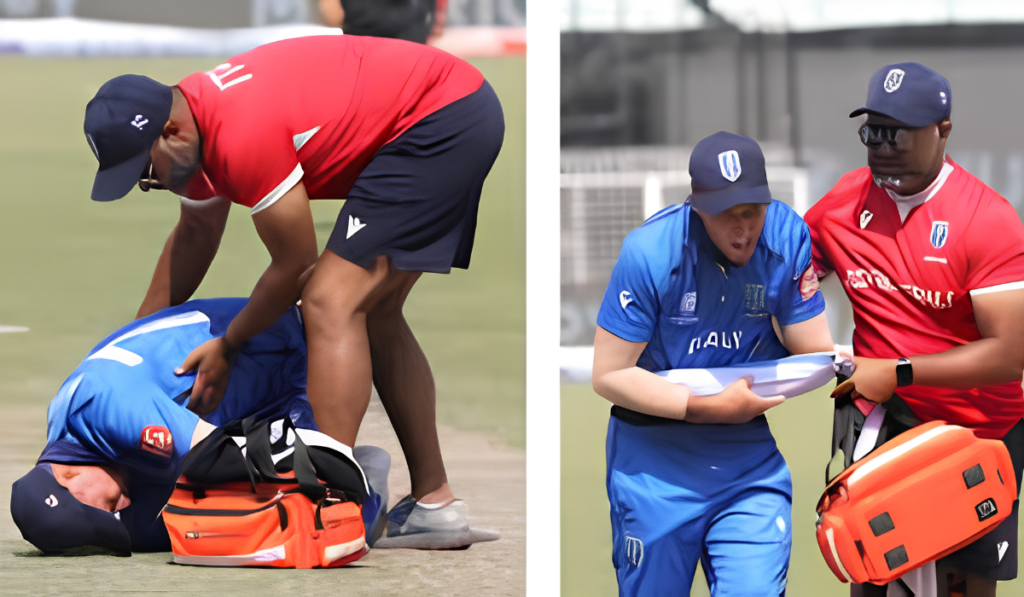
ODI cricket rules for a retired, hurt batsman are similar to the Test format, but bring added pressure because of the shorter format. As ODI innings comprise only 50 overs, teams can’t afford to wait too long for a player to get back.
- If a batsman retires hurt in an ODI
- The next batsman comes in to continue the innings.
- The injured player is planned to come back later.
However, the return must be before the end of the innings.
In any case, because of time pressure, the medical staff usually evaluates the player quickly.
Retiring hurts tend to occur from dehydration, cramps, or injuries after being battered by fast bowling at ODI cricket. Due to the fast-paced nature of the format, scoring rapidly in T20 follows a certain rhythm, and losing an effective batsman can turn things around for the innings.
For example, if a top-order batsman is forced to retire hurt early in the innings, it could put huge pressure on an inexperienced middle order, which could impact the scoring rate as well as partnerships.
Read more: Pakistan National Cricket Team Vs India National Cricket Team Timeline
Retired Hurt in Cricket T20
The role of a retired hurt in the cricket T20 format is huge as the nature of such matches is high intensity and ultra-fast. Wickets will flow, players sprint between wickets, hit with ferocity, and field at full throttle.
In T20 cricket, retired hurt scenarios typically arise due to:
- Muscle cramps
- Hamstring injuries
- Heat exhaustion
- Ball impact injuries
- Diving accidents during fielding
Due to the short nature of T20 innings, teams have a conundrum whenever a batsman is forced off the field. Slow recovery could lose wickets at a premium overs, but sending in lower-order batsmen too early might rob the finish.
In some instances, those players return to play out the final overs or are involved in a partnership that manages to steer the team towards an emphatic 50-over finish. Such times are the highlights in T20 cricket.
Is Retired Hurt Out?
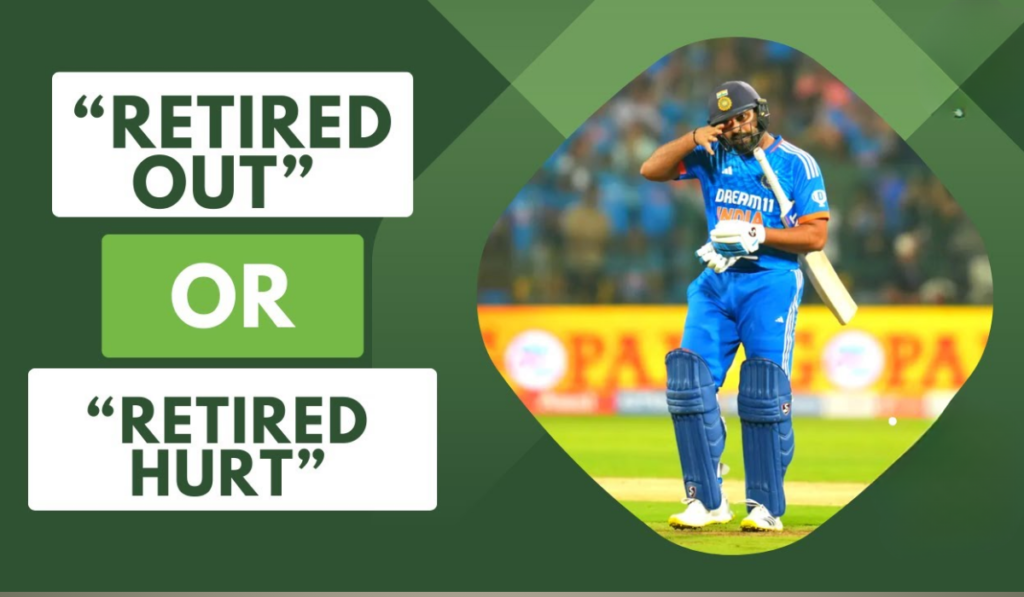
No, retired hurt is not an out.
This is one of the most important features of the rule. If a batsman is then forced to retire hurt, they do not lose their runs, strike rate, and batting figures. The batting average is also not impacted, as the player did not face official dismissal.
For example:
- That 75 runs scored by a batsman who is retired hurt would count in the match total.
- Not considered among the wickets lost by the player.
- In the fantasy cricket platforms, runs scored are usually converted to points.
This follows the standard way of how a batsman is represented on scorecards.
“Retired Hurt”
or
“Retired Not Out”
This prevents players from being punished too severely for getting an injury.
Read more: Cricket Team Names with Logo | Mumbai Indians Vs Royal Challengers Bengaluru 54th Match Scorecard
Famous Retired Hurt Moments in Cricket History
Cricket is, in fact, a game that consists of numerous poignant and brave retired hurt incidents across the history of the sport that still linger on in our minds.
Graeme Smith vs Australia (2009)
Pushing the limits of bravery in Test cricket to one of its highest peaks, Graeme Smith walked out with a broken hand against the mighty Australian national cricket team. He previously retired hurt but came out at No. 11 to attempt to save the Test match.
Although South Africa ultimately lost the game, he garnered respect worldwide for his determination.
Glenn Maxwell vs Afghanistan (2023 World Cup Edition)
Glenn Maxwell dropped at the key stage in his record double century vs the Afghanistan national cricket team due to severe cramps. It was not a formal retirement hurt, but it underlined how close a player can be to retiring on the spot through heavy physical exhaustion.
Ricky Ponting in the Ashes
In an Ashes Test once, Ricky Ponting retired hurt after being hit with a bouncer. He later returned to keep batting after receiving treatment.
Anil Kumble’s Fighting Spirit
There have been viable references as Anil Kumble came around with a jaw broken in Test matches there; lastly, he took 2 wickets. One of the greatest injury stories in cricket was created because of his toughness.
Hurt retired impact in cricket: Retired Hurt in Cricket
Injuries, retirements, and overall physical failures result in the one most significant match strategy transition. An established batsman losing his wicket means partnerships will be hard to come by, the team will struggle to score at any reasonable rate, and he is likely contributing to morale in the dugout.
Two or one wicket out and a top-order batsman is retired hurt, then inexperienced players will face quality bowling in tough conditions. In T20 cricket, if a finisher retires hurt during the death overs, the side would lose steam scoring rate-wise.
Logically, after such incidents, captains and coaches are accustomed to playing rapidly. They may:
- Change batting order
- Slow down the scoring rate
- Protect the remaining batsmen
- Delay aggressive shots
- Use all-rounders earlier
On occasions, the eventual use of a retired hurt comes as a shot in the arm for the team and temporarily reverses the balance towards the batting team.
Read more: Godfather of Cricket | Gully Cricket Team Names
Will Retired Injury-Rated Players Come out of Retirement in the Cricket World Cup?
Yes, retiring for hurt players frequently returns in the cricket context, specifically in more drawn-out configurations of the sport, which incorporate Test matches. It can be about the seriousness of the injury and where in the match it is.
However, medical teams today have a significant say in whether players return. Be it the increased awareness of concussions and long-term injuries, be it Neil Wagner and Mark Wood beginning to bowl with padding around their heads, or raising the standard for how much protection you really need, cricket today is more about safety than ever.
Players may return after:
- Pain relief treatment
- Bandaging injuries
- Hydration recovery
- Medical observation
- Physiotherapy support
However, if doctors find the injury life-threatening, then it is recommended that players not continue.
Is Sanju Samson Retired Hurt in Cricket?
Gained prominence after Sanju Samson looked ill at ease while batting or fielding during a handful of IPL and international matches.
There were even matches where Samson was seen briefly leaving the field because of specific injury or cramp fears, with supporters checking whether he had retired hurt. Such incidents demonstrate how closely the modern-day cricket followers keep track of player fitness updates.
Retired hurt is when a batsman leaves the innings due to an injury, but any cricketer will testify that this happens, mostly temporarily, on many occasions.
Myths relating to Retired Hurt in Cricket
The rules on retired hurt continue to baffle cricket fans at times. Retired Hurt in Cricket.
Myth 1: Retired Hurt = Out
This is false. The batsman is not out and can come back later.
Myth 2: Retired Hurt is Used Tactically By Teams
Only authentic injuries/illnesses apply to the rule. Tactical misuse is not allowed.
Myth No. 3: Batting Counts Have Disappeared
Runs yet to retire hurt are completely and utterly valid.
Myth 4: Players Can Never Come Back in T20 Matches
Cricketers can make a comeback later in T20 cricket if they are medically fit.
ICC Safety Rules and Medical Support: Retired Hurt in Cricket
Nowadays, with the help of the modern medical system, there are many ways to safeguard players in case they get injured and taken off precaution during their games.
Important safety measures include:
- On-field physiotherapists
- Concussion assessments
- Medical timeouts
- Hydration monitoring
- Protective equipment upgrades
Those systems mean that players do not endanger themselves by attempting to keep batting when the dangers of severe long-term injury outweigh their interests.
Impact of Retired Hurt on Fantasy Cricket
Retirement Hurt- Fantasy Cricket players keep a close check on retirement hurt since it changes the points and plans to form a team.
Usually:
- The runs scored before the retiree does count.
- Strike rate points remain active.
- No dismissal penalty applies.
- Future batting opportunities may be reduced.
How closely do fantasy users tend to follow injury updates during live matches?
Conclusion: Retired Hurt in Cricket
The rule of Retired Hurt in Cricket rules that protects the players in important ways. Cricket is a physically demanding sport, and injuries can happen at any stage. The retired hurt rule exists to allow a player to leave the field without losing his wicket, and if it is possible, he can return later once he has recovered.
They change the momentum of even the most heated Test cricket battles, and create emotional scenes that resonate with fans in T20 clashes where players are retired hurt. Many iconic cricketers have displayed immense bravery in coming back out to bat through pain and injury, hence retired hurt incidents adorn great tales in cricket history.
For fans, an understanding of retired hurt ensures that they may appreciate that balance between competitiveness and player safety. That rule balances risk to the athlete and the fairness of play. Retired Hurt in Cricket is an integral rule that even now holds the spirit of the game and applies to ODI cricket, T20 leagues, or even International Test matches.
FAQs: Retired Hurt in Cricket
What is the rule of Retired Hurt in Cricket?
Retired Hurt in Cricket refers to when a batsman who is injured or ill and has a serious need to leave the field for treatment, but cannot, as they will be dismissed. The player might return later in shape.
Is a player who retired hurt allowed to come back?
A retired hurt player may come back later in the innings after medical clearance, when fit as per India’s Playing Conditions debacle of October 2019
The odd thing is that retired hurt counts as out right?
No, retired hurt is not a form of dismissal in cricket.
What is the difference between retired hurt and retired out?
Retired hurt is an injury-related decision and does not count as an out, while a retired out is a tactical choice and generally does count as a dismissal.
Retired hurt batsman rules in ODI cricket
While injured batsmen in ODIs can return to continue their innings if they regain fitness, time pressure influences structural strategies.
Is Sanju Samson retired hurt?
Associate member teams: Sanju Samson is injured in some matches. Retired hurt officially depends on match records and scorecards.
Impact of retired hurt on batting average
No, as the batsman will not actually be out.
But what is the condition to take the player out of play with a retirement in case he or she has no injury?
The rule only applies in medical emergencies or injury.